
Early Identification and SEND Assessment Support through Patchwork
SEND Assessments & Support in Schools with Patchwork
Supporting children to thrive through inclusive and positive educational experiences.
Patchwork exists to support children, parents and schools with identifying learning needs and introducing the right support – even before diagnosis.
A connected platform that combines specialised screeners, practical support recommendations, strategy packs, student profile and service pathways, teachers and SENCOs have access to a single application that presents a comprehensive, joined-up picture for each child.
Patchwork believes that pupil voice is imperative to learning outcomes, which is why it is central to our ethos. By giving pupils the chance to input in how their needs are understood and how they receive support, we shape a Pupil Passport that captures what helps each child learn, what barriers exist, and what strategies work on an individual, and class-wide basis.
If you would like to know more about how Patchwork supports children within your school, get in touch with the team at Access2Learn today.
Patchwork by Access2Learn
Patchwork is a singular, digital platform that provides screening tools, practical support strategies and a universal service pathway for all students.
The idea for Patchwork originated from the firsthand experience of one of our founders, whose child required SEND support. With a drive to understand his neurodiversity and enable him to thrive, she discovered not only the value of individual support, but witnessed the challenges of the current school systems. Using this as a foundation, the platform was developed further by a multidisciplinary team of educational experts, and helps SENCOs, teachers and school leaders understand how pupils learn, what they need, and the learning techniques they are most comfortable with – without a formal diagnosis requirement.
By bringing together multiple sources of information: teachers’ observations, parents’ perspectives, screener results and a child’s own thoughts and feelings, Patchwork builds an effective picture of the support that would be best for that individual.
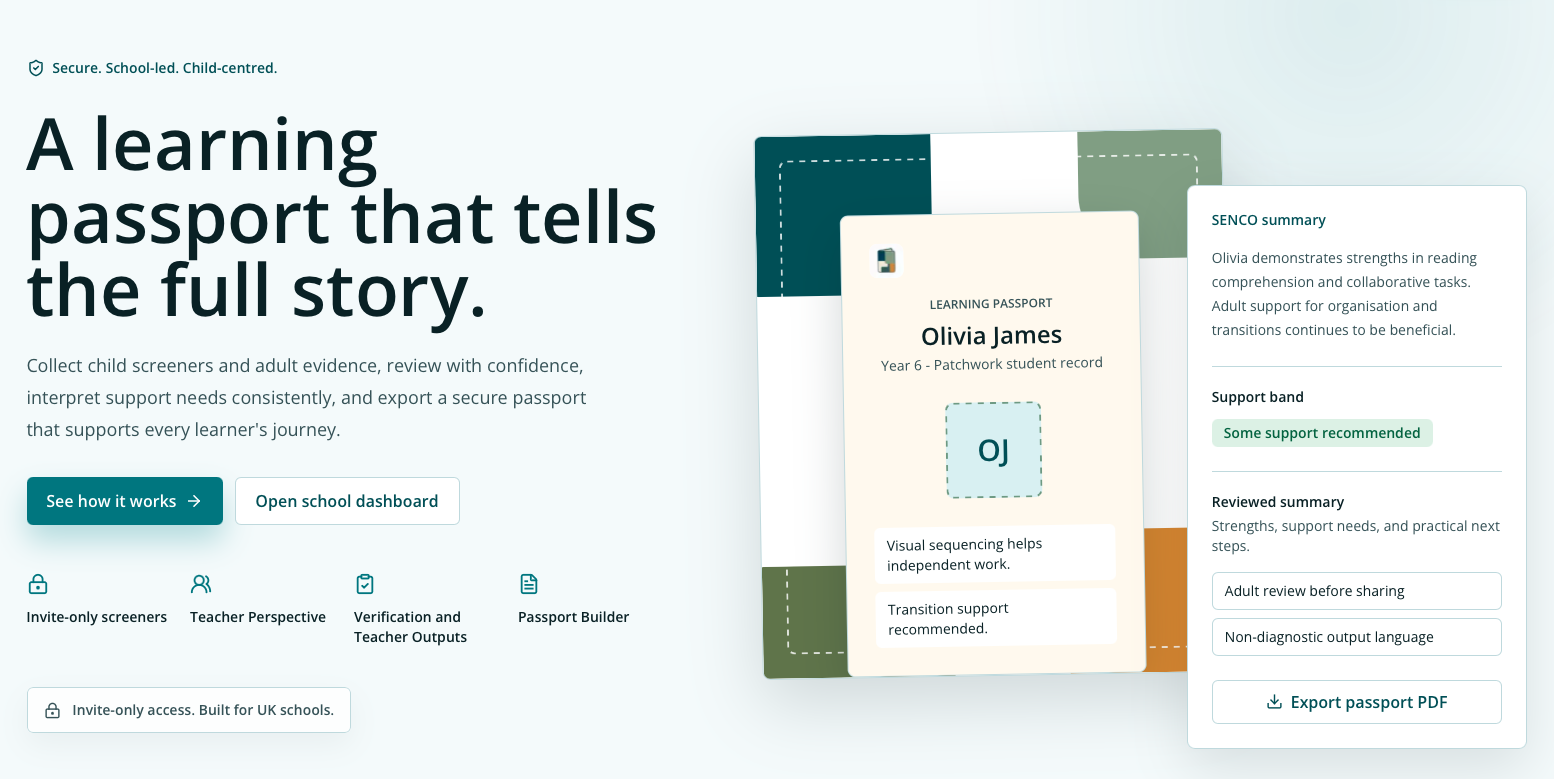
This knowledge is then documented and managed via a Learning Passport which travels with each child as they progress through their education. Importantly, it highlights what the pupil does well, what learning barriers exist, what support techniques are likely to help and how progress and impact will be reviewed.

The challenges schools face
A 2026 government report highlights that more than 20% of school-age children in England require SEND support. This means that waiting lists for diagnostic assessments continue to grow, support is delayed, and places at specialist educational centres are in more demand than ever before.
Schools working with SENCOs are becoming overwhelmed with caseloads, and levels of training available to teachers are varied. These factors, alongside the lack of a unified screen-to-support system, mean that some children’s needs are at risk of not being properly identified.
These challenges are the reason that Patchwork was developed – by providing teachers, SENCOs and parents with access to the most up to date screening tools, practical support and step-by-step service pathways, children receive a structured approach to learning that works for them on an individual level.
In addition, it provides peace of mind for parents that their child’s learning needs are recognised, and there is a strategy in place to help them succeed.
How Patchwork works
To understand how the platform works in practice, below is a step-by-step guide detailing each stage of Patchwork.
- Step 1 – Information gathering
The initial stage is to ensure there’s enough information to complete the picture. Teacher insights and verification, pupil voice through screening and optional parental insights are all logged into the platform.
- Step 2 – Identification
SENCOs and teachers can now explore a pupil’s strengths and areas of need. A Pupil Passport is generated for each pupil, alongside a Teacher Passport and whole class reports. This enables the ability to build both class-and-pupil-specific strategies.
- Step 3 – Centralised dashboard
SENCOs have access to a comprehensive dashboard which can be broken down into individual pupil reports when required. It allows SENCOs to track intervention and progression, alongside whole school data.
- Step 4 – Tailored recommendations
Patchwork will craft tailored recommendations and learner strategies to help support each child with their SEND needs. In addition, teachers, teaching assistants, SENCOs and parents can have access to customised handbooks, and various class and individual worksheets. These are available to download and use to support pupils in developing their skills in a range of areas of need.
- Step 5 – Holistic support for pupils
Following the learner strategies, learning support continues via Access2Learn’s pupil-centred support services. This includes a School Avoidance (EBSA) Programme, teenage coaching, literacy tutoring and counselling.
Built by SEND specialists
In order to fully understand the challenges and develop the right solution for pupils, teachers, SENCOs and parents, Patchwork was designed and created by a variety of educational industry experts and those with first-hand experience.
By collaborating with diagnostic assessors, specialist practitioners, specialist study skills tutors and a PhD researcher alongside teachers, SENCOs, parents and neurodivergent individuals, our team was able to build a structured framework that turns information, into action.
The support strategies and resources that are available through Patchwork have been reviewed by Ofsted inspectors, occupational therapists, educational psychologists, and experienced SENCOs and teachers to ensure suitability across EYFS right through to KS5 education.

Supporting earlier identification of SEND
Whilst it’s difficult to calculate how many undiagnosed pupils require SEND learning support, Patchwork helps SENCOs assess learning needs and provide children with SEND support that can be put into action – as soon as it is identified. Specific areas of need include:
- Literacy and language
- Numeracy and number sense
- Attention and executive function
- Social communication
- Sensory experiences
- Motor coordination
- Emotional wellbeing
- Day-to-day functional impact
By allowing teachers and SENCOs the opportunity to use modern needs assessment tools within the platform, it not only begins the evidence-gathering process, but it offers a graduated approach, which supports everyone with the right learning techniques without the need of a diagnosis.
Schools that choose to implement Patchwork will have a consistent, industry-leading platform at their fingertips that provides invaluable SEND support for families.
Benefits for SENCOs
- Centralised pupil information and evidence
- Consistency for inclusion across staff
- CPD for staff
- Easier tracking of interventions and impact
- Structured evidence to support meetings and referrals
- Reduced administrative burden
Benefits for SENCOs
- Greater confidence in identifying barriers to learning
- Quick access to practical classroom strategies
- Clear understanding of individual pupil needs
- Reduced time spent searching for support resources
Benefits for parents and families
- Increased involvement in understanding and supporting their child
- Improved communication with school
- Greater clarity around support strategies and next steps
- A shared Learning Passport that helps maintain consistency between home and school
Pupil Passports
A Pupil Passport is developed for each child to capture what helps them learn. Each passport is unique, and details practical strategies that work, alongside the pupil’s strengths and their specific areas of need.
This document provides both the school and family with a clearer picture of the child’s educational needs and will be reviewed each year as the student progresses. This means each new teacher, SENCO or school have immediate access to providing the right type of support for that pupil.
Patchwork’s screening and analysis, enhanced by teacher, parental and pupil insights allow a comprehensive passport – one that is designed to evolve with the child.
Resources and ongoing support
Access2Learn helps neurodivergent individuals from school age right through to adulthood with various ongoing support services and resources. Through coaching, counselling and tutoring for teenagers and adults, our aim is simple – to help SEND people thrive in education and the workplace.
Request a Patchwork demonstration
If you would like to explore how Patchwork could be a useful asset to your school and its pupils, please feel free to get in touch and book a demonstration with one of the team.
Patchwork – Helping Schools Remove Barriers to Learning Without Waiting for Diagnosis
Schools are under increasing pressure to meet a diverse range of learning, communication, sensory, and emotional needs, often while navigating lengthy waits for assessment and diagnostic services. In this context, early identification and timely support are critical to ensuring every child can thrive.
This webinar will explore how school leaders and SENDCOs can strengthen inclusive practice by moving beyond a “wait-to-identify” approach and adopting evidence-informed strategies that enable earlier intervention and support.
Ready to Get Started?